Integrated activities
The axis includes two complementary activities:
1. Building blocks for an Interdisciplinary and Policy Oriented Research portfolio
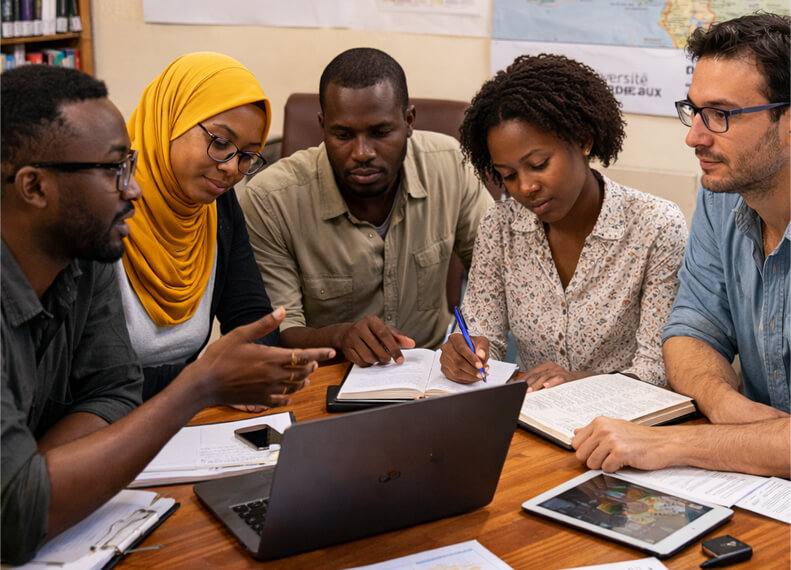
This activity assembles researchers from a diverse and highly complementary set of disciplines including: remote sensing, environmental sciences, plant sciences, economics, food science and nutrition, anthropology and political science.
2. A multi-year and multi-country, interdisciplinary research portfolio
Over the past two years, IPORA WP6 has developed 7 research protocols, including 4 that were submitted to international competitive calls for external funding. While each proposal focuses on a specific topic within the theme of Agrifood Systems and Nutrition, each one also features important complementarities further strengthening one another. Research in this axis takes place in Morocco, Côte d’Ivoire and Ethiopia.
Learn more
The axis includes two complementary activities:
1. Building blocks for an Interdisciplinary and Policy Oriented Research portfolio
This activity assembles researchers from a diverse and highly complementary set of disciplines including: remote sensing, environmental sciences, plant sciences, economics, food science and nutrition, anthropology and political science. Its current research portfolio includes:
- The Ethiopian Food Security Atlas (EFSA) developed as part of an interdisciplinary (Economics and Nutrition) and inter-university (UB and AAU) PhD thesis.
- The innovative mapping of national stakeholders engaged in Food and Nutrition policies, as part of an inter-disciplinary Post-Doctoral fellowship (Geography, Economics and Political Sciences).
- The piloting and improvement of new Food Value Chains analytical tools, as part of four interdisciplinary internships (Food Sciences and Economics) in Côte d’Ivoire and Ethiopia, conducted in partnership with the UN Food and Agriculture Organization (FAO) and supported by IPORA seed funding.
- The development of an interdisciplinary research community through regular scientific exchanges (online seminars and workshops, along with internal/external communication channels) facilitated by the WP6’s deputy coordinator. The research theme currently involves over 25 researchers from a wide array of scientific disciplines.
- The establishment of research partnerships with national and international stakeholders, among which the Ethiopian and the Ivorian National Information Platforms for Nutrition, CGIAR centers in Côte d’Ivoire (AfricaRice), Morroco (ICARDA), and Ethiopia (ILRI, CIMMYT, IFPRI), NGOs (Digital Green, Rikolto) and Private sector (Lersha, OCP Foundation)
2. A multi-year and multi-country, interdisciplinary research portfolio
Over the past two years, IPORA WP6 has developed 7 research protocols, including 4 that that were submitted to international competitive calls for external funding. While each proposal focuses on a specific topic within the theme of Agrifood Systems and Nutrition, each one also features important complementarities further strengthening one another. Research in this axis take place in Morocco, Côte d’Ivoire and Ethiopia. External funding was sought from the following sources:
- The Standing Panel on Impact Assessment of the CGIAR (€ 1.75 million, accepted for 3 years and renewable. It includes 1.25 million for a large-scale research program in Ethiopia, and 250,000 for preliminary work in Côte d’Ivoire and Morocco),
- The UM6P-J-PAL Agricultural Lab for Africa (€ 375,000, under review),
- The Fund for Innovation in Development (€ 1.5 million, under review).
Another application was submitted to an EU/Horizon Europe call in 2024 (requested: € 4.6 million). Although rejected, the rating and comments from reviewers encouraged a resubmission after improvement.