Research axis
Social equity in the context of informality

Overall motivation

This research axis emerged from WP7, where researchers in economics, political science and law explored the relationship between informality and social equity. Informality is a widely used concept in the social sciences and frequently appears in research on African societies, particularly in fields such as employment, social protection, urban governance, health and security. However, its meaning varies across disciplines.

Originally, the concept referred to the “informal sector”, describing economic activities that operate partly outside state regulation. Since Keith Hart’s work in Ghana in 1972 and its adoption by the International Labour Organization (ILO), the concept has evolved to include broader forms of informal employment, institutions and social norms. The boundary between formal and informal activities is often fluid, with many interactions and overlaps between the two.

Beyond economic activities, informality may also refer to the ways individuals and communities adapt to, reinterpret or bypass state regulations. Because of its importance, the concept has also become central to public policies aimed at supporting transitions between informal and formal systems.

Integrated activities

This research axis combines two complementary types of activities: the development of specific research projects addressing challenging situations of social equity in contexts of informality, and coordinated initiatives aimed at building shared interdisciplinary approaches.

Between 2022 and 2024, five research projects were launched, offering diverse perspectives on the relationship between informality and social equity. These projects explored topics such as informal solidarity and social protection systems in Africa, the role of labour inspection in the transition from informality to formality, and the interaction between legal and social norms shaping the behaviour of informal entrepreneurs. Other research focused on spatial justice in social housing policies and inequalities in access to water in Addis Ababa. Together, these studies provide an interdisciplinary understanding of how informality influences social and economic dynamics.

In parallel, coordinated activities supported a collective reflection on the concept of informality. Several projects developed a shared research questionnaire, while funding was secured to produce an anthropological documentary exploring situations of informality in employment, solidarity and enterprise. Regular interdisciplinary seminars also facilitated exchanges between researchers and the comparison of methodological approaches.

Academic validation

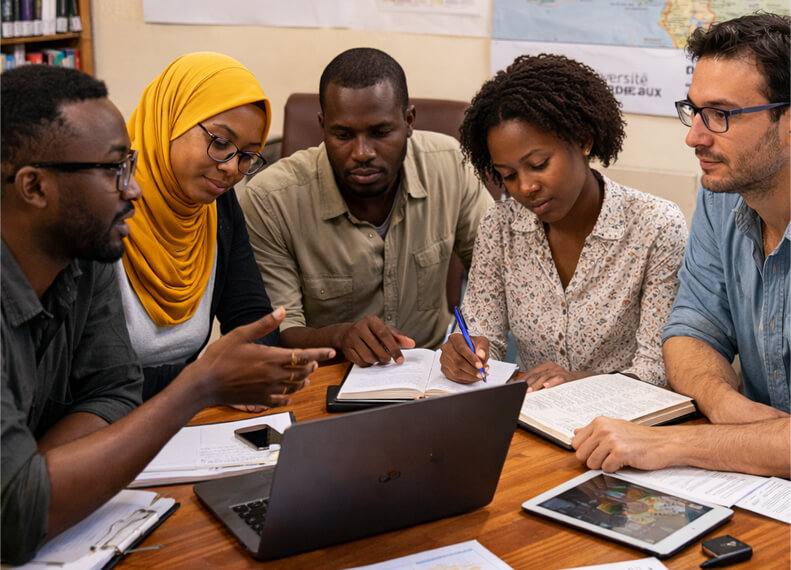
IPORA enabled the creation of an interdisciplinary research team addressing social equity issues in the context of informality. IPORA’s financial support and the establishment of a research network allowed for fundamental reflection on the notion of informality. It currently supports two doctorates, one post-doctorate fellows, and an application to a competitive call at the French National Research Agency (ANR).

Associated projects

Access to Water and Inequalities in Addis Ababa

Access to Water and Inequalities in Addis Ababa

Explore the inequalities in water access in Addis Ababa: understanding how economic status impacts water availability despite high connection rates to the citys water network.

More info

Factors and Consequences of Unemployment Among Young Graduates in Morocco and Ivory Coast

Factors and Consequences of Unemployment Among Young Graduates in Morocco and Ivory Coast

Analyzing unemployment among young graduates in Morocco and Ivory Coast: Challenges, socio-political impacts, and solutions for improved job market inclusion.

More info

Labor Inspection and Informal Employment in Africa

Labor Inspection and Informal Employment in Africa

Explore the significant role of labor inspection in addressing informal employment across Africa, from how it varies from Southern to North Africa, and its impact on transitioning to formal economies. This study delves into policies, inspector practices, and the complexities…

More info

Social housing and informal settlements in the context of socio-spatial injustice, inequality, and poverty in Addis Ababa, Ethiopia

Social housing and informal settlements in the context of socio-spatial injustice, inequality, and poverty in Addis Ababa, Ethiopia

Explore the impact of social housing and informal settlements on socio-spatial injustice, inequality, and poverty in Addis Ababa, Ethiopia, examining urban developments role in addressing these challenges.

More info

Social Protection Systems in Africa, International Comparisons

Social Protection Systems in Africa, International Comparisons

Examining the evolution of social protection systems in Africa against international aid goals on health, work, and poverty. This study delves into whether current changes remain externally influenced or show signs of local appropriation and impact.

More info

Standards and Performance in Informal Activities

Standards and Performance in Informal Activities

Examining the evolution of social protection systems in Africa against international aid goals on health, work, and poverty. This study delves into whether current changes remain externally influenced or show signs of local appropriation and impact.

More info